|
Discover
the hidden treasures of Drake Bay, Costa Rica with Tracie
"The Bug Lady"

Home
Tour
Basics
Meet
the Bug Lady
Tales
from the Edge
Media
Reservations
Links

Facts about Drake Bay, Costa Rica
Travel To
Drake Bay
Drake Bay
Area Map
Hotel
Information
Tips for Travelers
Tours
Recommended
Reading



|
|
|
Hemeroplanes sp
The rainforest of the
Osa Peninsula is truly a place of
magic. Here, disappearing acts,
trickery, and the art of illusion are
masterfully crafted in the theater of
life. Leaves may spring to life and
walk before your very eyes. Bark can
suddenly burst into flight. Twigs
incredibly stride from tree to tree.
Our
guests on The Night Tour often ask:
“What is the most amazing encounter
you‘ve ever had on the night tour?“.
Our answer is always the same: Without
question, none is more spectacular
than an encounter with Hemeroplanes,
a species of hawk moth
caterpillar. Yes, a caterpillar.
A
caterpillar may not seem so exciting
considering that we do, on occasion,
encounter Pumas, Ocelots, and even
Tapirs on The Night Tour. The amazing
transformation undertaken by the Hemeroplanes
caterpillar, though, truly defies the
imagination.
|
|
|

We
have been lucky enough to encounter Hemeroplanes
only a handful of times. Our first
encounter happened on a cool, drizzly
night during the month of August. It
was toward the end of the night and we
were headed towards town to drop off
our guests. As we reached the
suspension bridge which crosses the
Agujitas River, I spotted a large
caterpillar feeding on a plant about a
meter off the trail.
We
were immediately stricken by it’s
size. Having never before seen this
species, we bent down the leaf on
which it was feeding to better observe
and photograph it. At first glance,
this large caterpillar was quite
ordinary.
|
|
|

As Tracie
lowered the caterpillar's branch and I
snapped shots off with my camera, we
realized that the caterpillar was
changing....becoming something
entirely different.
|
|

After
posing placidly for a few shots, the
caterpillar suddenly released the twig
on which it was perched and hung
dangling by its rear set of legs. It
began to pull the tip of it's head
inward, puffing out the front part of
it's body.
Gradually,
previously hidden shades of yellow,
white and black lit up the
caterpillar‘s new “face“.
|
|

Then, what
appeared to be eyes, nostrils and
scales slowly began to materialize.
It quickly
dawned on us that this caterpillar was
transforming into snake right before
our eyes!
|
|
|

In just a
few seconds, Hemeroplanes
looked much more like an Eyelash Viper
(Bothriechis schelgelii) than
it did a caterpillar.
Just when
we thought it couldn’t possibly get
any weirder.....it did. The
caterpillar began to flail, as if
trying to strike out at us!
We stood
awestruck, watching this performance,
a rush of questions whirling through
our minds. Was this even possible?
|
|

Stunned by what we had just seen, we
returned home and immediately began
our search to identify this incredible
caterpillar. We found a great source
of information in 100 Caterpillars
by Jeffrey C. Miller, Daniel H.
Janzen, and Winifred Hallwachs.
|
|
|
 Based in Guanacaste
and Penn State, Dan Janzen and
Winifred Hallwachs have been
conducting ground breaking research on
the moths of Costa Rica, as well as
many other topics, for over thirty
years. Based in Guanacaste
and Penn State, Dan Janzen and
Winifred Hallwachs have been
conducting ground breaking research on
the moths of Costa Rica, as well as
many other topics, for over thirty
years.
Janzen
was instrumental in saving,
reforesting and preserving the Area de
Conservacion Guanacaste, a UNESCO
World Heritage Site.
|
|

According to their
incredible publication, this
caterpillar is quite rare to see. They
describe two similar species
previously collected in Costa Rica: Hemeroplanes
triptolemus occurs in the Dry
Forest while Hemeroplanes ornatus
occurs in the Rainforest.
According
to Janzen as caterpillars Hemeroplanes
sp. feed on the leaves of
apocynaceous vines. Every time we have
found them in Drake Bay they have been
feeding on Lacmellea panamensis,
an evergreen tree in the Apocynaceae
family which occurs in Nicaragua,
Costa Rica, Panama, Colombia and
Ecuador.
As an
adult, Hemeroplanes is a
fairly large sphinx
moth. Although beautiful in its
own right, the adult moth leaves no
hint of its spectacular previous
existence as a "snake caterpillar".

References:
Miller,
J. Janzen, D. Hallwachs,
W. 2006 100
Caterpillars The Belknap Press
of Harvard University Press
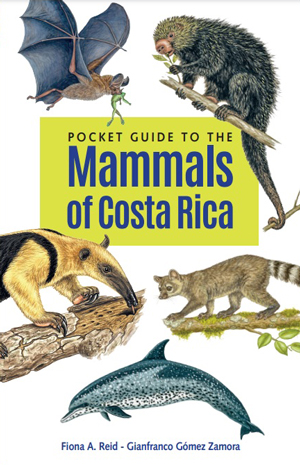
Click below
for more information about Gian's
book!
|
|
|
|
|
|


 Alien
Earthlings
Alien
Earthlings  The Dark Side
